Light Therapy for Macular Degeneration (AMD)
Why We Began Treating Dry Macular Degeneration Differently
For most of our career as ophthalmologists, dry macular degeneration created a frustrating conversation.
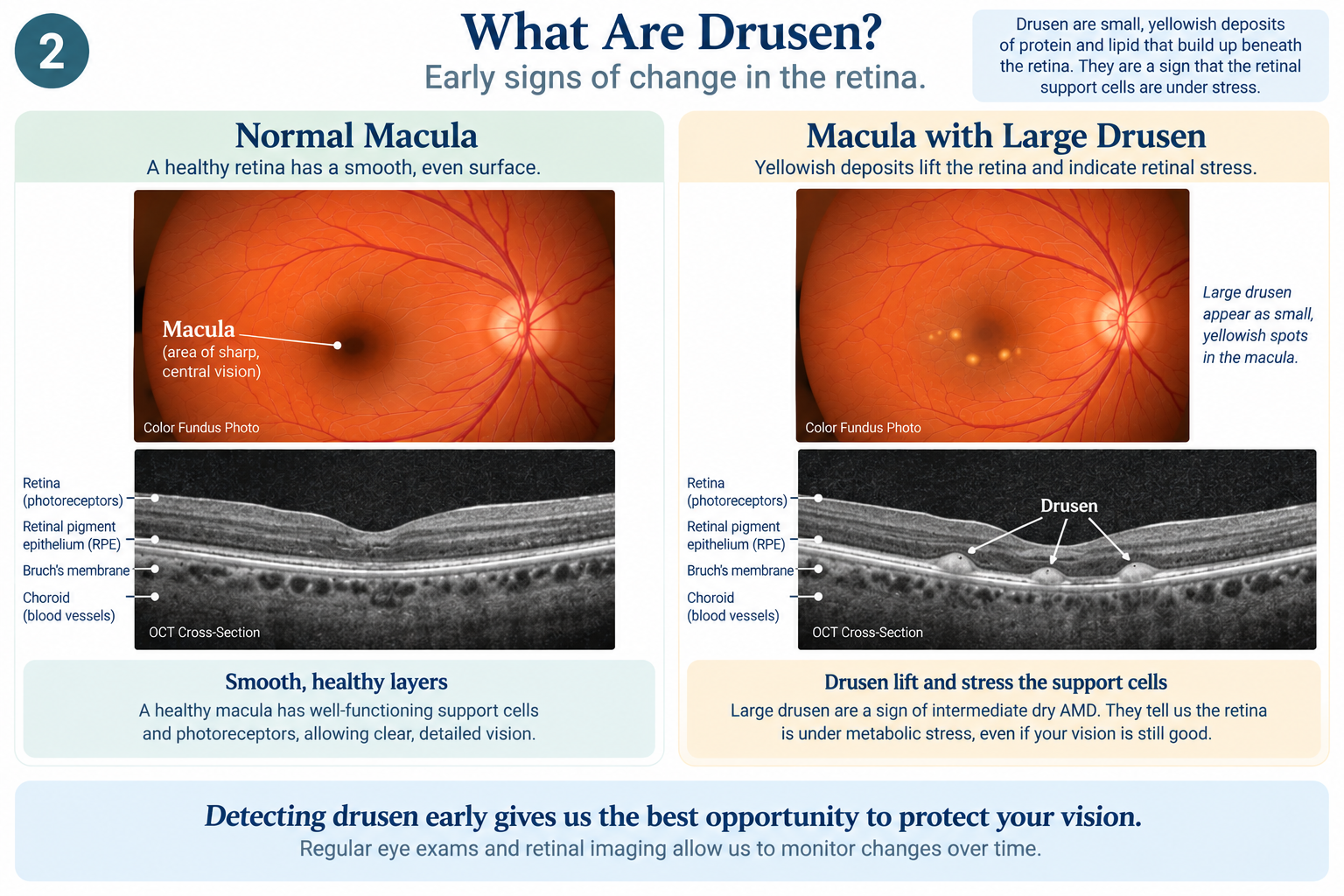
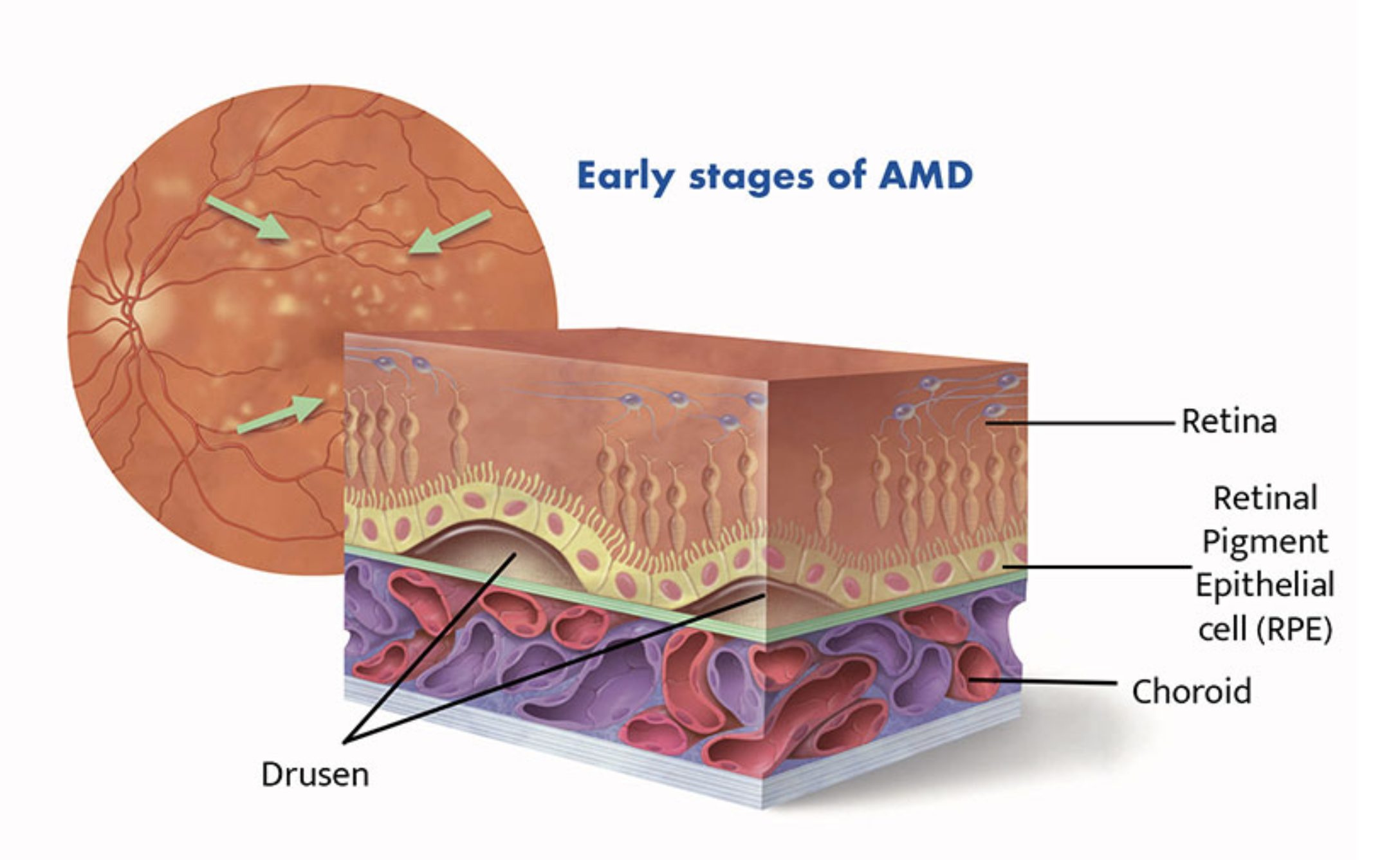
We could show a patient the large drusen in their macula. We could explain that these deposits were evidence that the retina was aging and under increasing metabolic stress. I could tell them that their vision might remain good for many years—or that the disease might eventually progress to geographic atrophy or wet macular degeneration.
What can we do to protect my vision?
Our recommendations were important, but limited. We could recommend AREDS2 vitamins when appropriate, a healthy diet, avoiding smoking, controlling cardiovascular risk factors, and monitoring carefully for progression.
But we could not actually treat the retinal cells themselves.
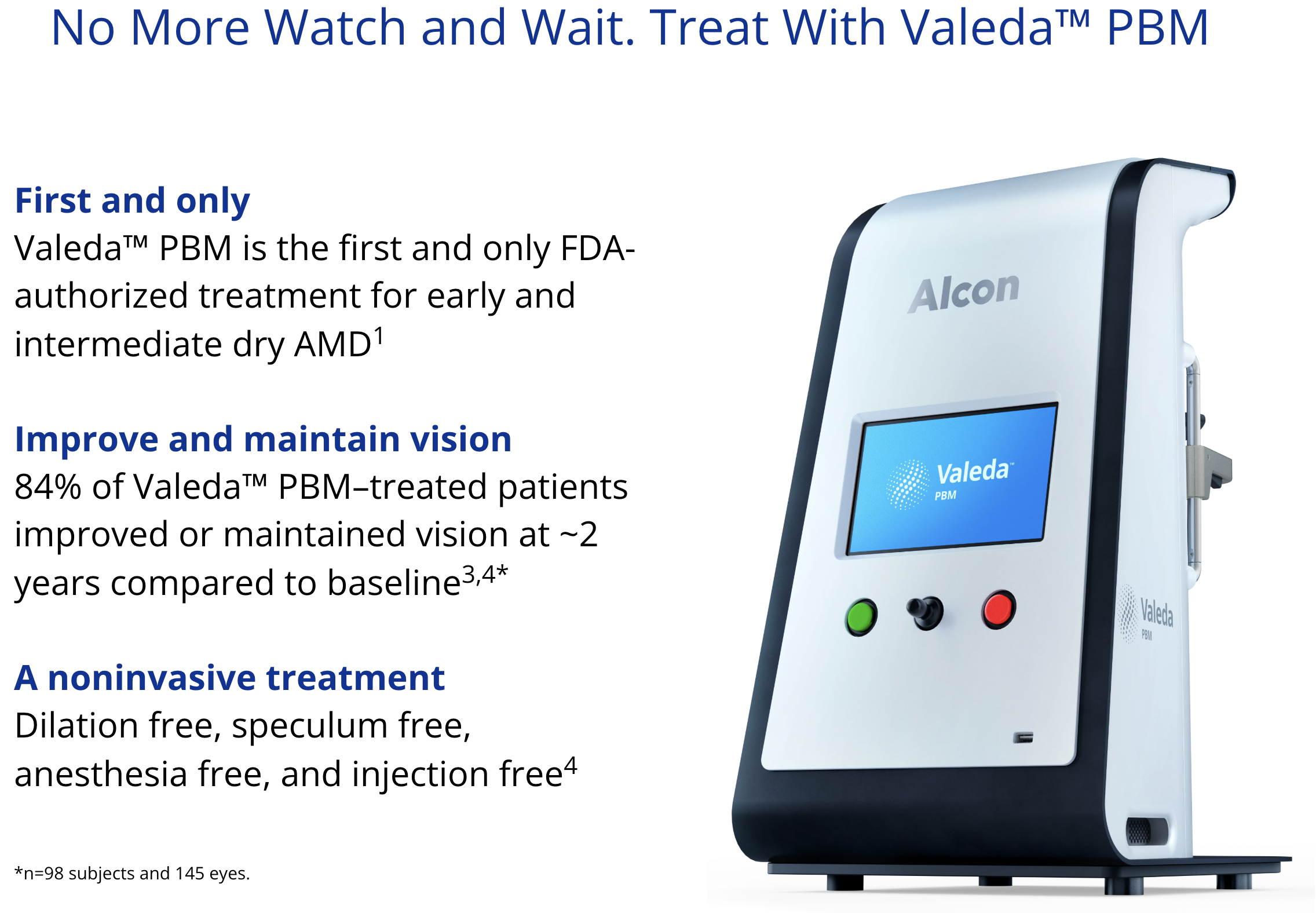
That is what interested us about Valeda photobiomodulation.
Why We Became Interested in PBM
I don't believe every new technology necessarily represents better medicine. Before bringing a new treatment into our practice, I want to understand the science, the clinical studies, the potential benefit, and—most importantly—the risks to our patients.
Valeda caught our attention because it approaches dry AMD differently.
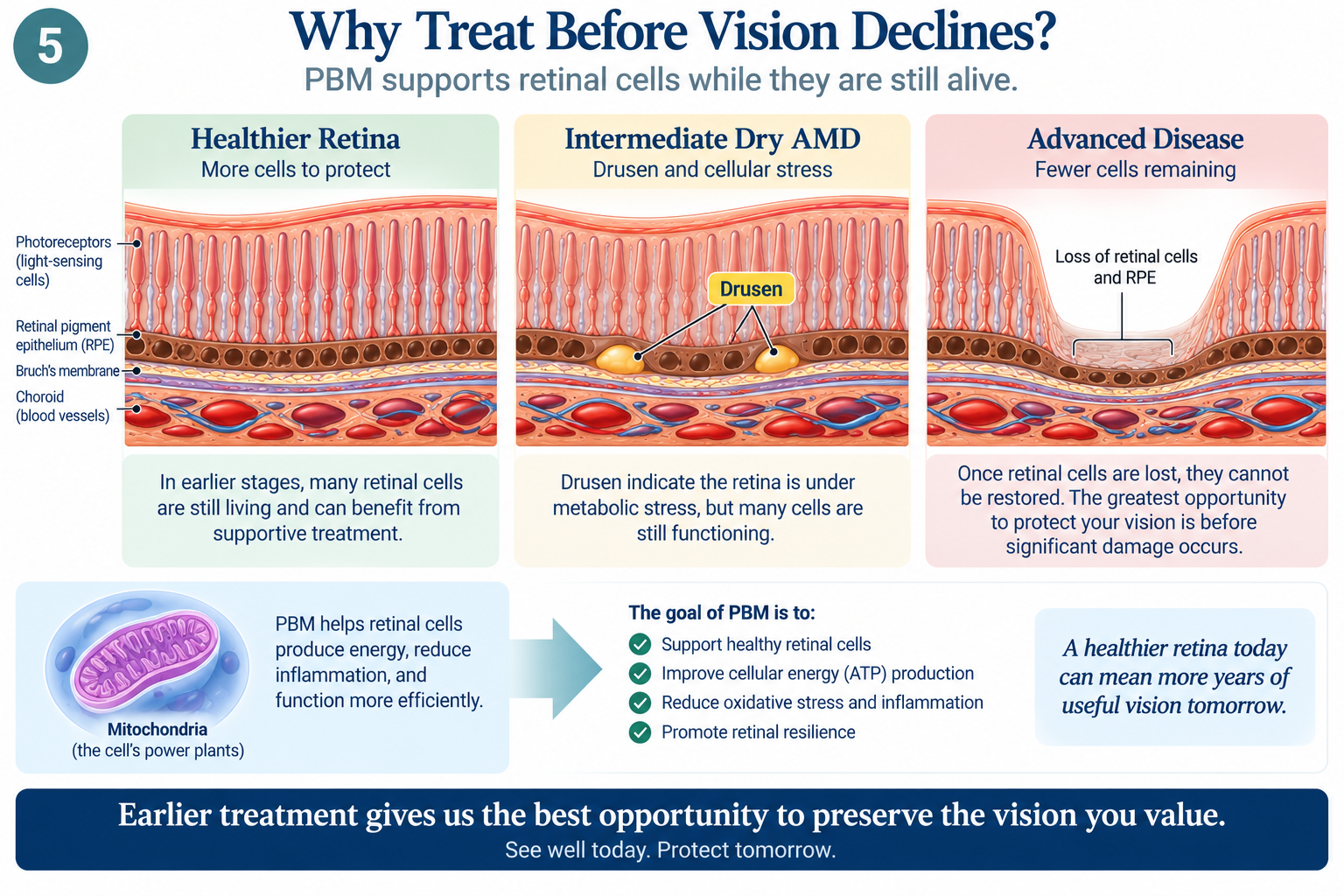
Rather than waiting for retinal cells to become permanently damaged, PBM attempts to support those cells while they are still alive and functioning.
The retina is one of the most metabolically active tissues in the human body. Its cells require enormous amounts of energy throughout our lives. Much of that energy is produced by mitochondria—the microscopic “power plants” inside our cells.
With aging and macular degeneration, mitochondrial function becomes less efficient. Oxidative stress and inflammation increase, and the retinal pigment epithelium becomes less able to support the photoreceptors responsible for our detailed central vision.
Valeda delivers specific wavelengths of light intended to stimulate mitochondrial activity and improve cellular function.
We often describe it to patients as helping an aging battery work more efficiently while it still has functioning cells.
It cannot bring dead retinal cells back to life. That is precisely why treating earlier may matter.
Why Large Drusen Matter
Many of the patients who interest us most for PBM still have surprisingly good vision.
They may see 20/20, 20/25, or 20/30 and wonder why we are discussing treatment at all.
The answer is that vision today and retinal health for the future are not necessarily the same thing.
Large drusen tell us that the environment beneath the macula has changed. The retina may still be functioning remarkably well, but those cells are under increasing stress.
Once geographic atrophy destroys retinal cells, we cannot restore them.
Our goal therefore isn't simply to make someone read another line on the eye chart next month.
Our larger goal is to preserve as much healthy, functioning retina as possible for the years ahead.
What We Hope PBM Will Accomplish
Clinical studies suggest that PBM may provide several benefits.
Some patients improve their visual acuity. Some notice improvements in contrast or the quality of their vision. Studies have also demonstrated changes in drusen and increasingly interesting evidence suggesting a reduction in the development or progression of geographic atrophy.
Those findings are important because they raise a bigger possibility: PBM may be doing more than temporarily improving an eye-chart measurement. It may be influencing the health and future course of the retina.
But there are important limitations.
PBM is not a cure for macular degeneration. It does not guarantee improved vision. It cannot guarantee that geographic atrophy will not develop. And it has not been demonstrated to prevent wet macular degeneration.
Some patients will improve. Some may remain stable. Some will continue to progress despite treatment.
That uncertainty is something I want every patient to understand.
What We Are Seeing in Our Own Patients
As we treat more patients, we are carefully following their vision, retinal examinations, OCT findings, drusen, symptoms, and experiences.
Over time, we will be able to tell our patients not only what was seen in clinical trials, but what we have observed in the people we personally care for.
Our own experience helps us understand what the treatment looks like in the patients sitting in front of us.
The Conversation Has Changed
For decades, intermediate dry AMD was largely something ophthalmologists watched.
We diagnosed it. We photographed it. We performed OCT scans. We recommended vitamins and healthy living. And we waited.
PBM gives us an opportunity to ask a different question:
Can we support these retinal cells before they are permanently lost?
We cannot promise that we can stop macular degeneration.
But if we can help retinal cells function better, preserve useful vision longer, and potentially reduce progression toward advanced dry AMD in some patients, that is meaningful.
For us, the objective isn't simply better vision at the end of nine treatments every four months.
The real objective is more years of useful vision—more years of reading, recognizing faces, driving when appropriate, enjoying hobbies, and remaining independent.
That is the future we are trying to protect.

Powered by:

Contact Info
Office Hours
Monday 8:00am - 5:00pm
Tuesday 8:00am - 5:00pm
Wednesday 8:00am - 5:00pm
Thursday 8:00am - 5:00pm
Friday 8:00am - 12:00pm
Saturday Closed
Sunday Closed